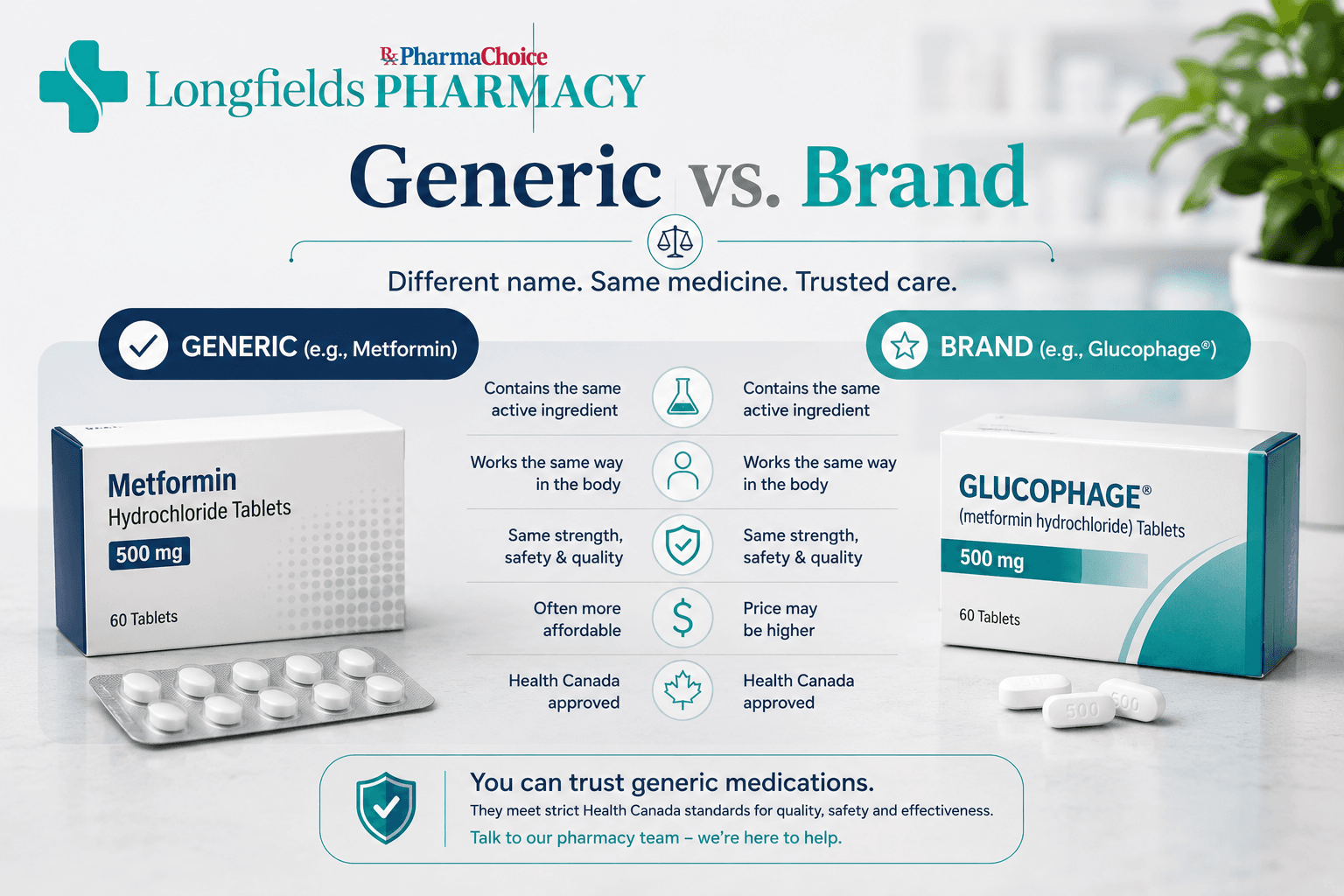
Generic vs. Brand Name Medications — The Truth From Your Pharmacist
Are generics really the same thing? What does Health Canada actually require? And when does the brand name version genuinely matter? Your Nepean pharmacist answers the questions patients ask most.
What Is a Generic Medication?
A generic medication is a copy of a brand-name drug that contains the same active ingredient in the same dose and dosage form — tablet, capsule, liquid — and is administered the same way. Generic drugs become available after the original manufacturer's patent expires, which in Canada typically takes 20 years from the date the patent was filed. At that point, other pharmaceutical companies can apply to Health Canada for approval to manufacture and sell their own version.
Generics can look different from their brand-name counterparts — different colour, shape, size, or coating — because these non-medicinal characteristics are not covered by patent. What cannot change is the active medicinal ingredient, its strength, and the way it is released into the body. The non-medicinal ingredients (fillers, dyes, binders) may differ, which is relevant for patients with certain allergies or sensitivities.
Health Canada's Bioequivalence Standard
Before a generic drug can be approved for sale in Canada, the manufacturer must demonstrate to Health Canada that their product is bioequivalent to the original brand-name drug. Bioequivalence means the generic delivers the same amount of active drug to the bloodstream at the same rate as the brand-name version.
Health Canada requires that the generic fall within an 80–125% range of the brand-name drug's bioavailability measurements in human clinical studies. In practice, approved generics almost always fall between 97% and 103% of the brand — the 80–125% threshold is a regulatory safety net, not a description of how different generics typically are.
This standard is equivalent to what the U.S. Food and Drug Administration (FDA) and the European Medicines Agency (EMA) require. Canada does not accept lower-quality generic drugs — every generic sold at Canadian pharmacies has met a rigorous federal approval process.
Are Generic Medications Really the Same?
For the vast majority of medications and patients, yes — generic drugs are clinically equivalent to their brand-name counterparts. When a patient switches from brand-name atorvastatin (Lipitor) to generic atorvastatin, or from brand-name omeprazole (Losec) to the generic, they should experience the same therapeutic benefit with the same risk of side effects.
Major medical and pharmacy associations in Canada — including the Canadian Pharmacists Association — support the use of generics as safe and effective alternatives. Pharmacists recommend generics routinely and confidently because the evidence supporting their equivalence is robust.
When Brand Name May Actually Matter
While generics are appropriate for the vast majority of patients, there is an important exception: drugs with a narrow therapeutic index (NTI). These are medications where the difference between a therapeutic dose and a toxic or subtherapeutic dose is very small. Even minor variations in bioavailability — within the approved range — can matter clinically for some patients.
Common narrow therapeutic index drugs include:
- Levothyroxine (Synthroid, Eltroxin) — thyroid hormone replacement
- Warfarin (Coumadin) — blood thinner requiring careful INR monitoring
- Digoxin (Lanoxin) — heart medication
- Lithium — bipolar disorder treatment
- Phenytoin (Dilantin) — anti-seizure medication
- Carbamazepine (Tegretol) — anti-seizure and mood stabilizer
- Cyclosporine (Neoral) — immunosuppressant after organ transplant
For these medications, many physicians and pharmacists recommend staying consistent — either always brand name or always the same generic manufacturer — rather than switching back and forth. If your doctor has specifically prescribed a brand name for a narrow therapeutic index drug, discuss any potential substitution with both your pharmacist and physician before changing. This is a clinical conversation worth having, not a reason to distrust generics in general.
Cost Savings — A Major Advantage of Generics
The financial benefit of generic medications is significant. In Ontario, generics are typically priced at a fraction of brand-name equivalents. The Ontario Drug Benefit (ODB) program, which covers eligible Ontario residents, reimburses the generic price for most drugs — meaning patients on assistance pay even less at the pharmacy counter.
For patients paying out of pocket or with private insurance, the savings can be substantial — hundreds of dollars annually for patients on multiple long-term medications. At Longfields Pharmacy, we are always transparent about the price difference between brand and generic options so you can make an informed choice. Choosing a generic for appropriate medications is smart financial management, not a compromise in your healthcare.
Ontario's Substitution Policy and Your Rights as a Patient
In Ontario, pharmacists are permitted — and in many cases required by ODB guidelines — to substitute a generic equivalent when filling a brand-name prescription, unless the prescriber has written "no substitution" on the prescription. This policy exists to ensure patients benefit from cost savings unless there is a specific clinical reason to use the brand.
Importantly, you have rights as a patient:
- You can always request the brand-name version — though you may pay the price difference yourself
- Your pharmacist must inform you when a substitution is being made
- If your doctor has written 'no substitution' on your prescription, the pharmacy must honour that
- You can ask your doctor to specify brand-only if there is a clinical reason for it
- You should always tell your pharmacist if you have experienced problems after switching between brand and generic versions
Talk to Your Longfields Pharmacist
Questions about your specific medications — whether to take generic or brand, how to manage costs, or whether a switch is right for you — are exactly what pharmacists are here for. At Longfields Pharmacy in Nepean, we offer comprehensive medication reviews to help you understand everything you are taking and make the most informed decisions possible.
A medication review at Longfields is a no-cost, confidential appointment where you sit down with your pharmacist to review all your prescriptions, over-the-counter drugs, and supplements — ensuring nothing is falling through the cracks and your medication plan is as cost-effective as possible.
Related Articles
Medical Disclaimer: The information in this article is intended for general informational purposes only and does not constitute medical advice. Always consult your pharmacist or physician before making any changes to your medications, treatments, or health routine.