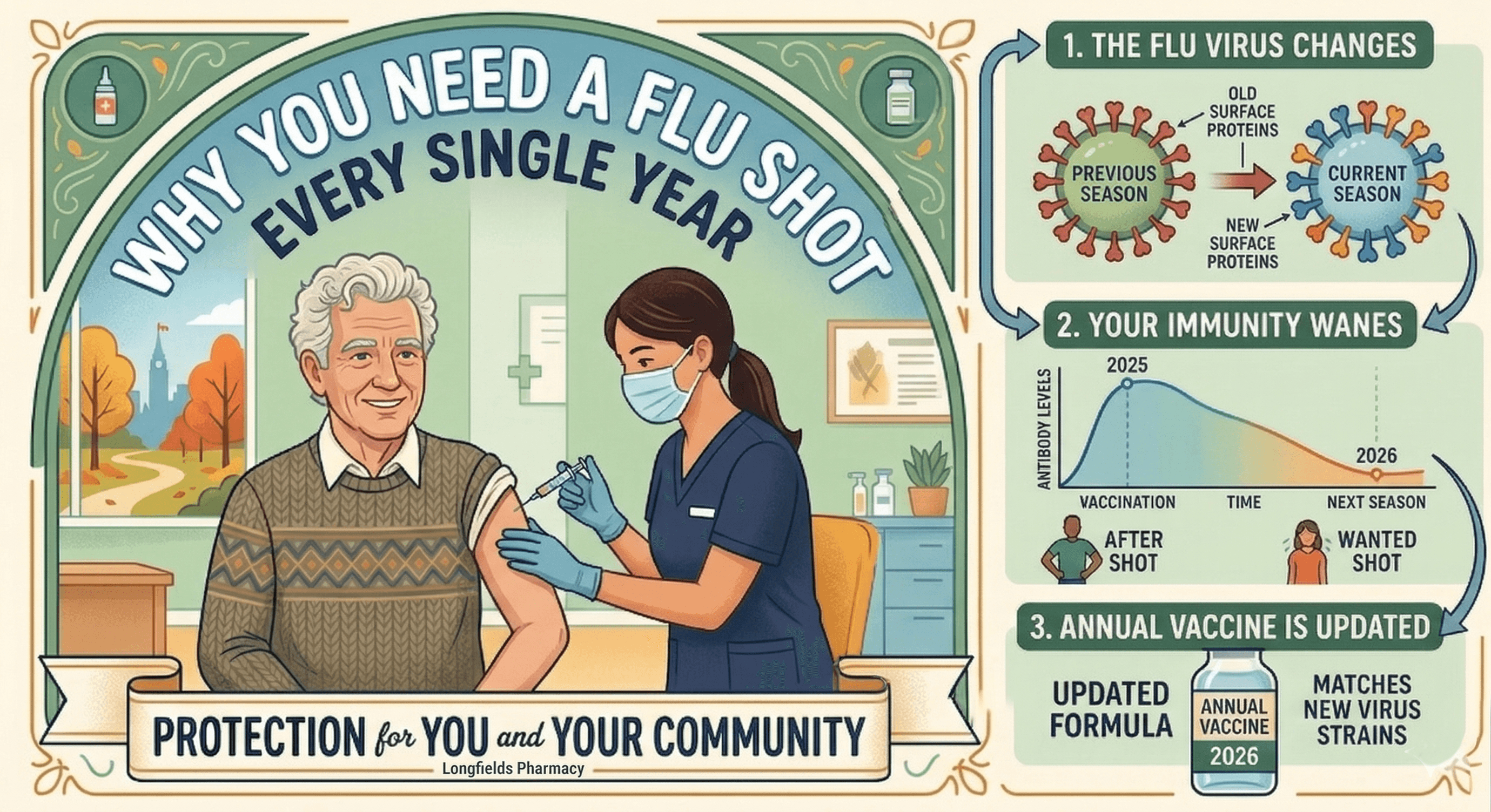
Why You Need a Flu Shot Every Single Year
"I got it last year" — one of the most common reasons people skip their flu shot. Here's why last year's vaccine won't protect you this season, and why the flu shot you get today is genuinely different from the one you got twelve months ago.
The Flu Virus Is Not the Same as Last Year
The most important reason to get a flu shot every year is straightforward: the influenza viruses circulating this season are almost certainly different from those that circulated last year. Unlike chickenpox or measles — which are genetically stable viruses that do not change significantly over time — influenza viruses are defined by their extraordinary ability to mutate. Every flu season brings a new viral landscape.
This is not a flaw in vaccine technology or a conspiracy to make you buy more vaccines — it is a fundamental property of the influenza virus itself. Understanding the two mechanisms by which flu viruses change helps explain why annual vaccination is a public health necessity and not just a precaution.
Antigenic Drift — Constant Gradual Change
The influenza virus replicates at an enormous rate inside infected cells — billions of copies made every day during an active infection. Like all RNA viruses, influenza lacks the proofreading mechanisms that DNA viruses use to correct copying errors. The result is a high mutation rate: small, random changes in the viral surface proteins called haemagglutinin (H) and neuraminidase (N) occur constantly.
Over time, these small changes accumulate in a process called antigenic drift. The virus's surface gradually becomes sufficiently different that the antibodies your immune system made in response to last year's vaccine no longer recognize the new virus as efficiently. Think of it like a wanted poster that slowly becomes outdated — the criminal has had plastic surgery over twelve months, and the old photo is no longer a reliable match. Your immune system needs an updated "wanted poster" every year.
Antigenic Shift — Occasional Dramatic Change
While antigenic drift is gradual and predictable, antigenic shift is the more dramatic and potentially dangerous form of influenza evolution. It occurs when two different influenza A strains simultaneously infect the same host cell — often a pig or bird — and exchange entire gene segments during replication. The result can be a completely new subtype of influenza to which virtually no human population has any prior immunity.
Antigenic shift is the mechanism behind pandemic influenza. The 2009 H1N1 "swine flu" pandemic, the 1968 H3N2 "Hong Kong flu," and the catastrophic 1918 "Spanish flu" all resulted from antigenic shift events. When a shift occurs, existing seasonal flu vaccines provide little or no protection, and the world must rapidly develop and deploy a new vaccine for the pandemic strain.
How the WHO Selects Each Year's Vaccine Strains
Developing the annual flu vaccine is a remarkable global scientific effort. The World Health Organization (WHO) coordinates a worldwide influenza surveillance network involving over 150 national influenza centres in more than 130 countries. These laboratories continuously collect and analyse influenza viruses circulating in their regions and report their findings to WHO collaborating centres.
Twice a year — once for the Northern Hemisphere season and once for the Southern Hemisphere — WHO convenes expert consultations to review the surveillance data and make recommendations for which strains should be included in the next season's vaccine. This decision must be made approximately six months in advance to allow enough time for vaccine manufacturing. The standard seasonal flu vaccine covers four strains:
- Two influenza A strains (typically H1N1 and H3N2)
- Two influenza B lineages (B/Victoria and B/Yamagata)
The selected strains change from year to year based on which viral variants are predicted to be most prevalent in the coming season. This is an imperfect science — predicting which flu strains will dominate six months from now involves inherent uncertainty — but when the match is good, flu vaccine effectiveness can be 50–70% or higher. Even in seasons with partial strain mismatch, vaccination still reduces disease severity, hospitalization risk, and mortality.
Waning Immunity — Why Even a Good Match Fades
Even setting aside viral mutation entirely, there is a second reason why annual vaccination is necessary: immunity from last year's flu shot wanes over time. Studies show that vaccine-induced antibody levels decline noticeably within 6–12 months of vaccination. By the following flu season — 12 months later — the protection provided by a prior year's vaccine has diminished significantly, particularly in older adults whose immune systems mount weaker initial responses and experience more rapid antibody decline. Getting vaccinated every fall ensures you enter flu season with your protection at its peak.
High-Dose Flu Shots for Adults 65 and Over
Older adults face a double challenge with flu vaccination: they are at higher risk of serious illness from influenza, and their immune systems produce weaker antibody responses to standard-dose vaccines. This is why high-dose flu vaccines were developed specifically for adults aged 65 and older.
High-dose influenza vaccine (Fluzone High-Dose) contains four times the amount of antigen as the standard formulation, which stimulates a stronger immune response in older adults. Clinical trials have shown high-dose flu vaccine to be approximately 24% more effective at preventing influenza in seniors compared to standard-dose vaccine, and to produce fewer flu-related hospitalizations. In Ontario, high-dose flu vaccine is available at select pharmacies. Ask our team at Longfields Pharmacy about availability for patients 65+.
Common Flu Shot Myths — Debunked
The injectable flu vaccine contains inactivated (killed) virus particles — it is physically impossible for it to cause influenza. Some people experience mild arm soreness, low-grade fever, or fatigue for 1–2 days after vaccination, which is the immune system responding to the vaccine — not a flu infection.
As explained in this article, flu viruses mutate continuously and vaccine-induced immunity wanes within 12 months. Last year's shot provides meaningfully reduced protection against this season's strains.
Healthy adults can and do get severe flu. Even if you recover fully, you can transmit influenza to vulnerable people in your life — elderly family members, infants, or immunocompromised individuals — who face much greater risk. Vaccination protects both you and those around you.
Flu season in Ottawa typically runs from October through April, with peaks in December–March. Getting vaccinated in December, January, or even February can still provide significant protection for the remainder of the season.
The Convenience of Getting Your Flu Shot at Longfields Pharmacy
Longfields Pharmacy makes getting your annual flu shot as easy as possible. We offer flu shots without an appointment — simply walk in during our regular business hours. The entire process takes less than 15 minutes, and our private consultation area ensures your comfort and privacy.
The flu shot is free for all Ontario residents with a valid OHIP card under the Universal Influenza Immunization Program (UIIP). If you have questions about eligibility, side effects, vaccine interactions with your medications, or whether the high-dose vaccine is right for you, our pharmacists are here to help. There is no better time to protect yourself — and those you love — than right now.
Related Articles
Medical Disclaimer: The information in this article is intended for general informational purposes only and does not constitute medical advice. Always consult your pharmacist or physician before making any changes to your medications, treatments, or health routine.